Ridan Mehran Mahbub

Bangladesh’s Readymade Garment (RMG) industry is the backbone of the country’s economy, transforming a war-torn nation in the 1970s into a country exporting apparel products worth around US$50 billion today. RMG exports have risen from a tiny share in the early 1980s to dominating the majority of Bangladesh’s exports today, reaching about 84% of total exports in FY2022–23 and remaining well above 80% in recent years. This scale has created jobs for roughly four million people and transformed women’s participation in paid work, since women make up the majority of garment workers. However, the same dependence that made RMG a miracle also makes Bangladesh vulnerable to external shocks. Changes in global fashion demand, tariffs, or logistics can ripple through foreign-exchange earnings, factories, and household incomes almost immediately, as seen recently when U.S. tariff threats and export disruptions reminded everyone how sensitive the sector is to external events.
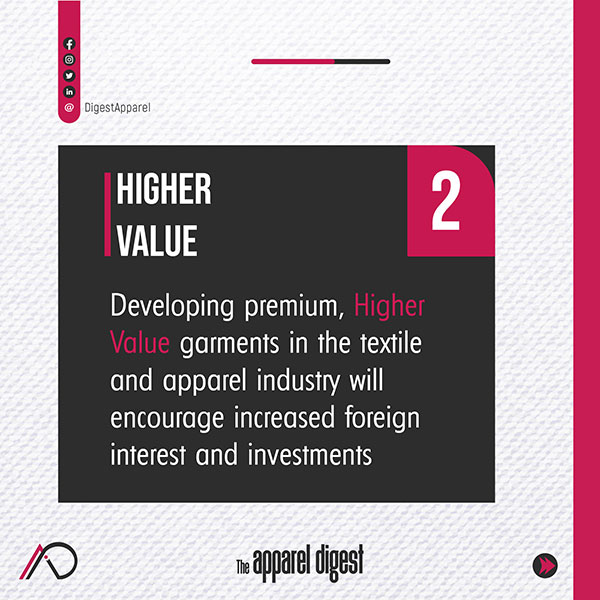
This brings us to a very important question: how can Bangladesh work toward building a stronger industry, one that is self-sufficient and independent of external shocks? The answer is not to abandon garments, because no country can or would want to replace the strongest engine of the economy, especially one of such a massive scale, overnight. Bangladesh is the world’s second-largest apparel exporter, holding around a 6–7% share of the global market, and that position gives it bargaining power and brand recognition with buyers. What must change is what Bangladesh exports and how it exports. The industry needs to move beyond a focus on products that bring small profit margins, transforming low-margin manufacturing into higher-value product lines, faster delivery models, and more diversified buyers. This is where an “industry-based diversification” strategy becomes practical. Bangladesh’s RMG industry needs to upgrade and broaden the core while building new industries that grow out of it, so diversification happens through expansion rather than being destroyed because of pressures from other nations.

One of Bangladesh’s biggest advantages is what economists call external economies of scale: the productivity and cost benefits that come not just from one firm growing, but from thousands of firms clustering together. The RMG boom in Bangladesh over the last few decades created dense networks of factories across the country, supported by subcontractors, freight handlers, testing labs, compliance auditors, and a skilled, low-cost labor force. These shared systems lower costs for every factory and make the whole industry faster and more reliable. These spillovers are why Bangladesh can still deliver huge volumes at competitive prices. Our next focus should be to use this exact advantage to deliver higher-value outcomes. This can include specialized industrial zones for man-made fibers, technical textiles such as geotextiles or agrotech, and high-end knitwear.
However, in order to make this jump sustainably possible, complementary industries have to grow alongside the garments industry. At the moment, Bangladesh still imports the majority of the raw materials needed for the fastest-growing segments, especially man-made fiber fabrics, specialized trims, and certain chemicals. As a result, factories lose time waiting for supplies and struggle to meet rules-of-origin requirements for trade preferences after LDC graduation. This again puts Bangladesh at risk from external shocks, as seen with the fire in the cargo region of Hazrat Shahjalal Airport in Dhaka. If Bangladesh expands its domestic capacity in man-made fibers, modern weaving and finishing, accessories, and sustainable packaging, it can cut lead times and unlock categories like athleisure, outerwear, stretch blends, and recycled-fiber garments that dominate apparel demand in recent years and are most likely to continue doing so in the coming years. The point is not just to substitute imports, but to gain an upper hand in accessing untapped markets strategically, so it can be a pioneer in the field when the time comes. When fabrics and trims are made locally, Bangladesh can compete with the rest of the world on speed and variety, not only price. The whole world is emphasizing the creation of new products for the future, whether through Taiwan’s focus on semiconductors or the push toward the AI boom by the United States and China. This needs to happen for Bangladesh as well if it truly wants to become an economic superpower and maintain the competitive edge in the coming years.

As the world experiences the AI boom, technological advancement will likely be the most important aspect of this evolution story. Global buyers now reward suppliers who can deliver products quickly, consistently, and sustainably, and those outcomes increasingly rely on technologically advanced manufacturing. Factories that adopt AI-assisted planning, computer-vision quality checks, predictive maintenance, digital sampling, and automation in cutting and sewing can reduce rejects, shorten production cycles, and enter precision-heavy product niches. Although automation raises anxiety about jobs, especially in a sector employing millions, it is also important to note that Bangladesh faces a harsher reality if it does not upgrade: losing orders to more technologically advanced competitors would erase livelihoods faster than any careful transition toward work that requires higher skill. Moreover, the fear that a technological upgrade might take over the workforce is not necessarily true, as seen during the ICT revolution in the past. Technological advancement is usually skill-biased, and thus constantly upgrading the skills of the workforce to keep track with the pace of global development will allow Bangladesh to upgrade naturally without losing jobs.
Recently, we have seen AKH Group, one of the largest garment producers in the country, collaborate with Bangladesh RMG Centre to introduce the Garment Business Administration (GBA) Diploma course to upgrade their workers. Such investments in the workforce by other companies can transform our labor force and position it to lead in the future. The realistic policy choice for the factories is to combine investment in technology with large-scale reskilling of the workforce. This can allow the millions of workers employed in this industry, especially women, to move to better-paid roles in machine operation, maintenance, CAD, supervision, and quality management. Since most of our competitors, including India and Vietnam, are investing heavily in both manpower and AI, it is incredibly important for Bangladesh to do the same in order to maintain its edge.
I also believe sustainability should not be treated as a compliance burden but as a force that gives Bangladesh a competitive edge. Bangladesh already has the largest concentration of green apparel factories in the world, and BGMEA’s Sustainability Vision 2030 suggests the industry is positioning itself for decarbonized and water-efficient production. As brands in Europe and North America become increasingly strict about environmental requirements, and as consumers become more willing to pay higher premiums for cleaner supply chains, “green at scale” can be Bangladesh’s signature advantage, especially when combined with AI that reduces energy waste. This can also reposition Bangladesh’s global image as a country that promotes sustainability and reduces waste, rather than the “dirty and unclean” image it is often associated with today.
Last semester, I took a course on International Trade with Réka Juhász at the University of British Columbia (UBC), and it felt like studying the present and future of globalization with someone actively shaping the conversation. Réka Juhász, a 2025 Bank of Canada Governors’ Award winner and recipient of multiple major research grants from universities around the world, is one of the leading scholars driving today’s debates on industrial policy and development. In class, we did not treat trade as a settled, “free markets always win” story. Instead, we start from the definition of industrial policy as intentional state action to change a country’s economic structure, often through targeted, “vertical” support for specific sectors or activities such as R&D.

That framing matters because it explains why industrial policy has surged back into the mainstream in recent years, even though it was viewed negatively for many decades after World War II. The last decade of trade shocks, supply-chain breakdowns, and intensifying U.S.–China competition has pushed governments to stop relying on markets alone. Analysts now describe a worldwide “industrial policy renaissance,” led by major economies trying to steer green transitions, secure critical supply chains, and rebuild domestic production capacity. Even Trump’s tariff-first approach, whatever one thinks of its effectiveness, helped re-ignite political momentum for governments to “do something” about deindustrialization and strategic dependence between countries, opening space for a broader and more sophisticated industrial-policy agenda that countries are still debating today.
What makes Reka Juhász such a central figure in this new wave of industrial policy is that she is part of a group of economists researching on the empirical facts throughout human history for when and how industrial policy works. Her research on the infant-industry argument shows that temporary protection can help firms adopt new technologies and become globally competitive, but only under specific conditions. It is important to understand that industrial policy isn’t magic; it can fail if politics, incentives, or learning dynamics are wrong, something Bangladesh has struggled with at different points in its development. Since Bangladesh is going through a period of major political change, with a revolution, upcoming elections, and nationwide discussions about reform, this moment creates uncertainty but also opens space to rethink how industrial policy is designed and governed. If reform efforts prioritize transparency, institutional accountability, and corruption-free investment, they can create the conditions under which industrial policy is far more likely to succeed.
Given we are successful in creating such a condition, Bangladesh’s RMG industry can benefit greatly from industrial policy. The discussions and case studies we have had in class align closely with what Bangladesh needs. The RMG industry requires targeted government support, much as seen in countries such as China or even India, to upgrade ready-made garments into higher-value products, incentives for technology and AI adoption to raise productivity, and coordinated investment in complementary sectors such as textiles, accessories, chemicals, logistics, and design. If Bangladesh commits to this path, I believe the RMG industry will stop being a fragile pillar of the economy and become a massive platform, one that still earns the country its exports today, while building the industrial future it needs for tomorrow.
Ridan Mehran Mahbub is the Special Correspondent for North America at The Apparel Digest. He is pursuing a Bachelor of International Economics at the University of British Columbia (UBC) in Vancouver, Canada, where he is a recipient of the International Leader of Tomorrow (ILOT) Award. He is currently on an exchange programme at the National University of Singapore (NUS).